


Dr Jacqueline Matthew January Seminar Series
December 17, 2025
We were pleased to welcome Dr Jacqueline Matthew - Clinical Research Fellow/Sonographer at King's College London - who delivered her talk “From Noise to Signal: A Clinical Researcher's Perspective on Translating Advances in Prenatal imaging into Practice"
as part of our Seminar Series.
Abstract: Over the past decade, machine learning approaches in prenatal imaging has advanced from exploratory academic prototypes to clinically usable, real-time tools, but the path between those two endpoints is rarely straightforward. In this talk, Jacqueline offered a clinical researcher’s perspective on translating biomedical engineering innovations into real-world impact, tracing the journey from the iFIND project’s early breakthroughs in automated fetal imaging to the creation of Fraiya, an AI-driven ultrasound platform now entering clinical deployment. She unpacked the technical, clinical, and regulatory hurdles that shape this trajectory: data acquisition at scale, annotation complexity, model robustness, pipeline optimisation for real-time use, clinical safety engineering, regulatory strategy, and integration with NHS digital ecosystems. Beyond the technical achievements, the session reflected honestly on the innovation “gaps” that researchers and engineers encounter when stepping into entrepreneurship. From productising research outputs, building 'with' clinicians and service users not just 'for' them, securing buy-in, navigating procurement, and proving value in operationally stretched healthcare services. The aim was to provide a pragmatic and motivating roadmap for researchers and innovators seeking to turn biomedical AI research into deployable, sustainable solutions in healthcare.
Seminar Series Event: “From Noise to Signal: A Clinical Researcher's Perspective on Translating Advances in Prenatal imaging into Practice.
Date and Time:
Thursday 22 January 2026, 15:00 – 16.00 hrs (GMT)
Location:
K39, King's Building, Strand Campus
Attendance: Mandatory for all DRIVE-Health students, therefore please accept the calendar invitation.
Registration:
Alumni and wider King's College London research community all welcome - please email drive-health-cdt@kcl.ac.uk to let us know if you would like to attend.
Biography
Jacqueline is a clinical academic, sonographer, and MedTech entrepreneur with over 20 years of experience in advancing pregnancy care through compassionate, technology-driven solutions. Specialising in ultrasound and fetal MRI, Jacqueline’s work focuses on leveraging cutting-edge imaging technologies to improve screening, diagnosis, and care for pregnant women.
With a PhD in advanced 3D ultrasound and fetal MRI, Jacqueline uses machine learning to refine diagnostic pathways, pushing the boundaries of what’s possible in prenatal care. As Clinical Lead and Chief Medical Officer at an early-stage health tech startup, she has been at the forefront of developing a real-time AI-powered pregnancy ultrasound platform, with ambitions to transform how scans are performed, enhancing diagnostic accuracy, and empowering healthcare professionals to deliver more informed and compassionate care.
Jacqueline’s work has earned her widespread recognition, including being named one of the inaugural winners of the NHS England CAHPO Gold Award for Excellence, which celebrates health professionals who exemplify exceptional contributions to healthcare and the NHS values.
Share
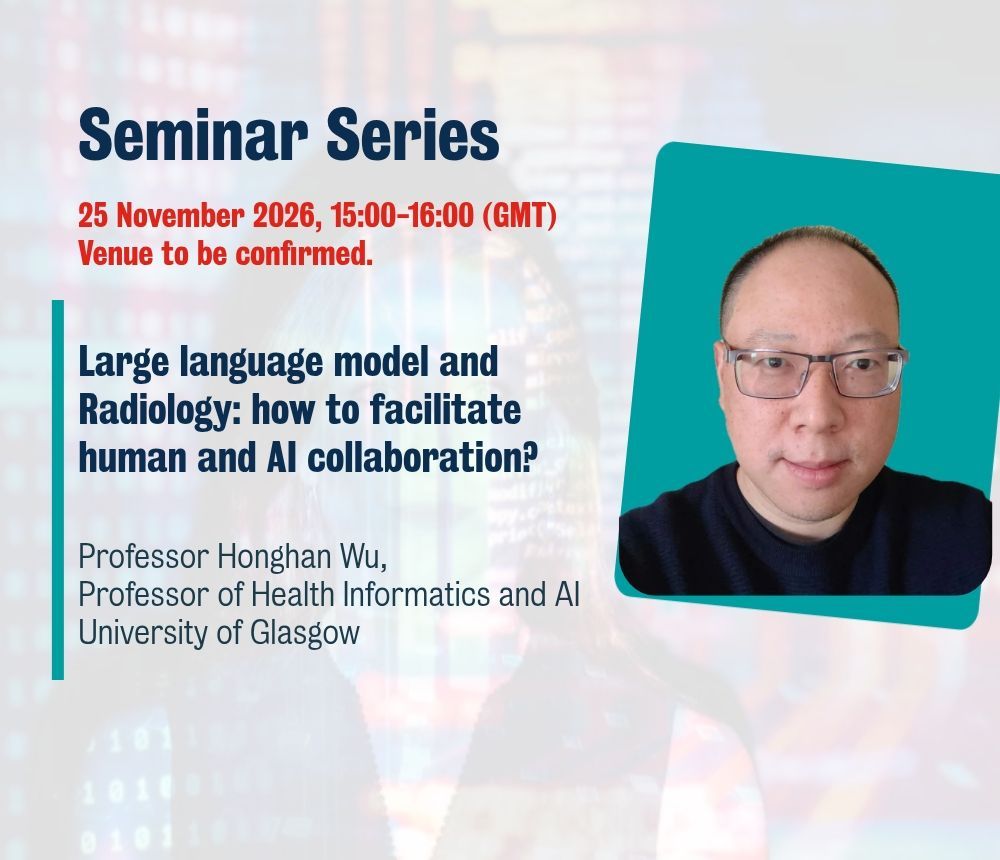
We are looking forward to welcoming Professor Honghan Wu, Professor of Health Informatics and AI at the University of Glasgow, who will deliver his talk “Large language model and Radiology: how to facilitate human and AI collaboration? " as part of our Seminar Series. Abstract: In this upcoming talk, Professor Honghan Wu explores the essential shift from viewing AI as a potential replacement for radiologists to recognizing it as a critical collaborative partner. Moving beyond basic tasks like detection and triage, the presentation highlights how AI can address practical clinical "pain points," such as reducing automated protocoling time by up to 60% and decreasing the time spent communicating with providers and patients by 30%. Professor Wu will present recent research on using knowledge-retrieval and Large Language Models for clinical report error correction and generation. The session concludes with an examination of the real-world deployment lifecycle, discussing the challenges of monitoring the over 700 FDA-cleared radiology AI devices currently in practice Seminar Series Event : “Large language model and Radiology: how to facilitate human and AI collaboration?" Date and Time: Thursday 25 November 2026, 15:00 – 16.00 hrs (GMT) Location: Venue to be confirmed. Attendance: Mandatory for all DRIVE-Health students; a calendar invitation has already been sent. Registration: Alumni and wider King's College London research community all welcome - please email drive-health-cdt@kcl.ac.uk to let us know if you would like to attend. Biography Honghan Wu is a Professor of Health Informatics and AI, based in the School of Health and Wellbeing of the University of Glasgow, where he leads the research theme of data science and AI. Prof Wu is a co-director of Health Data Research Scotland. He also is an honorary professor at Hong Kong University, an honorary associate professor at Institute of Health Informatics, UCL, and a former Turing Fellow of The Alan Turing Institute, UK's national institute for data science and artificial intelligence. Prof Wu holds a PhD in Computing Science. His current research focuses on machine learning, natural language processing, knowledge graph and their applications in medicine.
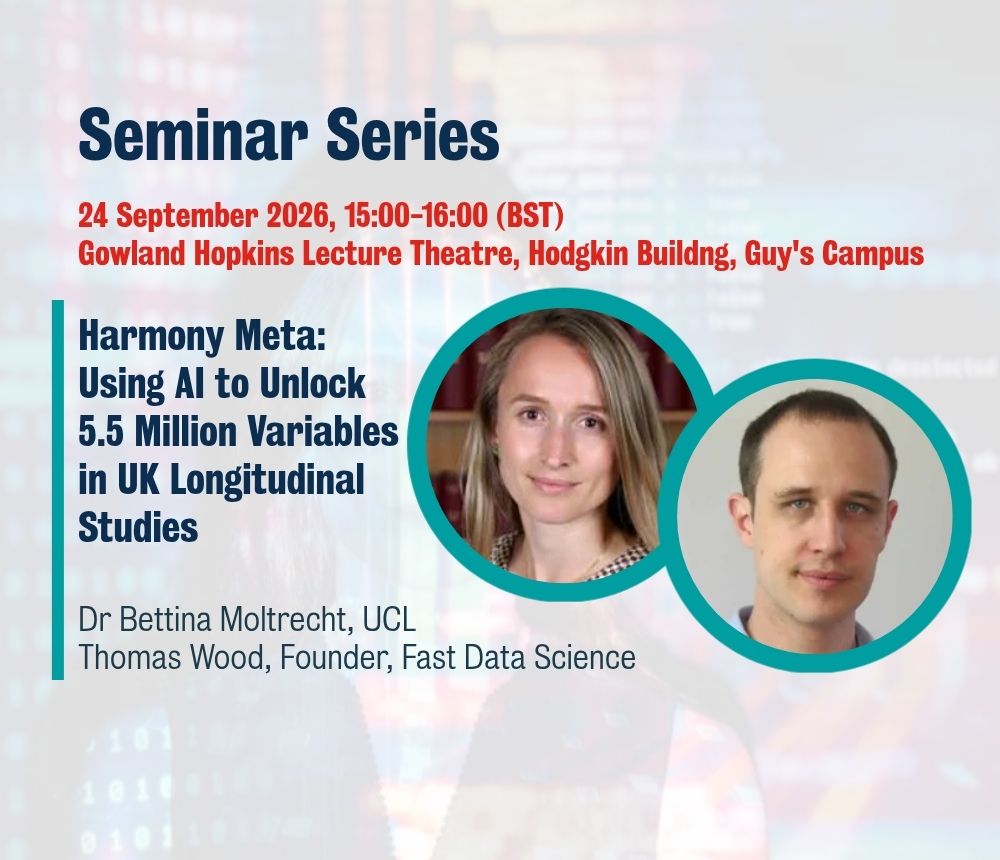
We are looking forward to welcoming Dr. Bettina Moltrecht and Thomas Wood to introduce Harmony Meta , a groundbreaking platform developed over the past year to bridge the gap between disparate study catalogues and registers. While traditional data discovery relies on exact keyword matching, Harmony Meta utilizes Large Language Models and vector indexing to allow for semantic searching across 5.5 million variables . Abstract: This session will demonstrate how researchers can now locate longitudinal data using approximate synonyms—for instance, a search for "dyslexia" will successfully retrieve variables related to "difficulty reading." The platform indexes nearly every major longitudinal study ever conducted in the UK, including the Millennium Cohort Study , the 1970 British Cohort Study , and Born in Bradford . The presenters will discuss the technical backend of converting millions of variables into vectors and the practical implications for harmonizing data across different cohorts to identify population mental health trends. Try the Tool: https://harmonydata.ac.uk/search Seminar Series Event : " Harmony Meta: Using AI to Unlock 5.5 Million Variables in UK Longitudinal Studies" Date and Time: Thursday 24 September 2026, 15:00 – 16.15 (BST) Location: Gowland Hopkins Lecture Theatre, Hodgkin Building, Guy's Campus. Attendance: Mandatory for all DRIVE-Health students; a calendar invitation has already been sent. Registration: Alumni and wider King's College London research community all welcome - please email drive-health-cdt@kcl.ac.uk to let us know if you would like to attend. Biographies Dr. Bettina Moltrecht Dr. Bettina Moltrecht is a mental health researcher based at University College London (UCL) and Anna Freud a UK-based mental health charity for children and families. Bettina combines a clinical, tech and research background, and has been co-leading the Harmony project with the aim to enhance population mental health research. Bettina is co-founder of UCL's Digital Mental Health Hub, and is co-investigator on various clinical trials to evaluate mental health interventions in the NHS. Thomas Wood Thomas Wood is the founder of Fast Data Science and the lead developer for the Harmony Meta backend. He holds a Master’s in Physics from Durham University and a Master’s in Computer Speech, Text and Internet Technology from the University of Cambridge. With over a decade of experience in machine learning and NLP, Thomas has consulted for the NHS, Tesco, and Boehringer Ingelheim. He also works as an expert witness and is working on NLP solutions for clinical trials, and generative AI solutions for legal question answering. Note on Funding and Partners: Harmony Meta was funded by the ESRC and developed in collaboration with Population Research UK (PRUK), the UCL Centre for Longitudinal Studies, DATAMIND UK, The Alan Turing Institute, and UK Research and Innovation.