



Dr Abhi Pratap October Seminar Series
October 22, 2025
We were thrilled to welcome Dr Abhi Pratap - Global Clinical Development Lead at Boehringer Ingelheim who delivered our October Seminar Series. In his talk “Why Mental Health Needs More Than New Drugs: Using Digital Health to Bring Patient-Centredness to Research and Care", Abhi shared case examples from emerging clinical studies to show how digital health can bridge the gap between clinical research and patient care in mental health. We will explore digital health solutions that help quantify the real-world experiences of health that matter to people - bringing us closer to understanding what treatments work for whom, why, when, and for how long.
Abstract:
Innovation in mental health treatment has been strikingly limited compared to other fields of medicine. In the last 15 years, fewer than five truly novel psychiatric drugs have received regulatory approval. This stagnation reflects multifaceted challenges linked to heterogeneity of psychiatric disorders often lacking biological markers grounded in disease biology. Additionally, there is significant reliance on subjective clinician-, rater-, or patient-reported outcomes, which increases variability in trial outcomes and poses challenges in patient selection and endpoint determination. Clinical studies also encounter persistent obstacles, such as high dropout rates, poor generalizability, and endpoints that frequently do not reflect what patients and their families value most. Consequently, there is a critical gap in new treatment development that are patient-centered, enhancing quality of life in real-world settings.
Use-case-centered implementation of digital health technologies offers a realistic path to address many of these barriers. Real-world data collected from smart devices can enable the continuous and ecologically valid capture of mood, cognition, behavior, and functioning, augmenting traditional, episodic assessments. This richer measurement framework can enhance sensitivity to change, reduce trial inefficiencies, and ground outcomes more directly in patients lived experience. In addition, the same smart devices can be used to deliver digital adaptations of psychosocial interventions, expanding access to evidence-based care and offering personalized and scalable options for populations that have been historically underserved due to stigma, geography, or cost.
Dr. Abhi Pratap is the Global Clinical Development Lead at Boehringer Ingelheim, where he oversees clinical development programs for digital therapeutics aimed at addressing unmet needs in serious mental illnesses. Before joining Boehringer, he worked at Biogen, managing one of the largest decentralised studies on cognitive trajectories in real-world settings in collaboration with Apple.
With over 15 years of experience in translational biomedical research, Dr. Pratap has led numerous health research studies that promote partnerships between academia and industry. His primary focus is on using digital health technologies to gain a deeper understanding of the real-life experiences of individuals with neurological and psychiatric disorders. His cross-sector research aims to accelerate patient-centered clinical development in central nervous system (CNS) disorders. Most recently, he led a successful pivotal Phase III trial targeting experiential negative symptoms of schizophrenia (NCT05838625) using a digital therapeutic. This study is among the first confirmatory trials to show improvement in negative symptoms to date.
Additionally, Dr. Pratap serves as an adjunct faculty member at the University of Washington in Seattle and Boston University, and he is a visiting research fellow at King’s College London.
Share

We are looking forward to welcoming Professor Honghan Wu, Professor of Health Informatics and AI at the University of Glasgow, who will deliver his talk “Large language model and Radiology: how to facilitate human and AI collaboration? " as part of our Seminar Series. Abstract: In this upcoming talk, Professor Honghan Wu explores the essential shift from viewing AI as a potential replacement for radiologists to recognizing it as a critical collaborative partner. Moving beyond basic tasks like detection and triage, the presentation highlights how AI can address practical clinical "pain points," such as reducing automated protocoling time by up to 60% and decreasing the time spent communicating with providers and patients by 30%. Professor Wu will present recent research on using knowledge-retrieval and Large Language Models for clinical report error correction and generation. The session concludes with an examination of the real-world deployment lifecycle, discussing the challenges of monitoring the over 700 FDA-cleared radiology AI devices currently in practice Seminar Series Event : “Large language model and Radiology: how to facilitate human and AI collaboration?" Date and Time: Thursday 25 November 2026, 15:00 – 16.00 hrs (GMT) Location: Venue to be confirmed. Attendance: Mandatory for all DRIVE-Health students; a calendar invitation has already been sent. Registration: Alumni and wider King's College London research community all welcome - please email drive-health-cdt@kcl.ac.uk to let us know if you would like to attend. Biography Honghan Wu is a Professor of Health Informatics and AI, based in the School of Health and Wellbeing of the University of Glasgow, where he leads the research theme of data science and AI. Prof Wu is a co-director of Health Data Research Scotland. He also is an honorary professor at Hong Kong University, an honorary associate professor at Institute of Health Informatics, UCL, and a former Turing Fellow of The Alan Turing Institute, UK's national institute for data science and artificial intelligence. Prof Wu holds a PhD in Computing Science. His current research focuses on machine learning, natural language processing, knowledge graph and their applications in medicine.
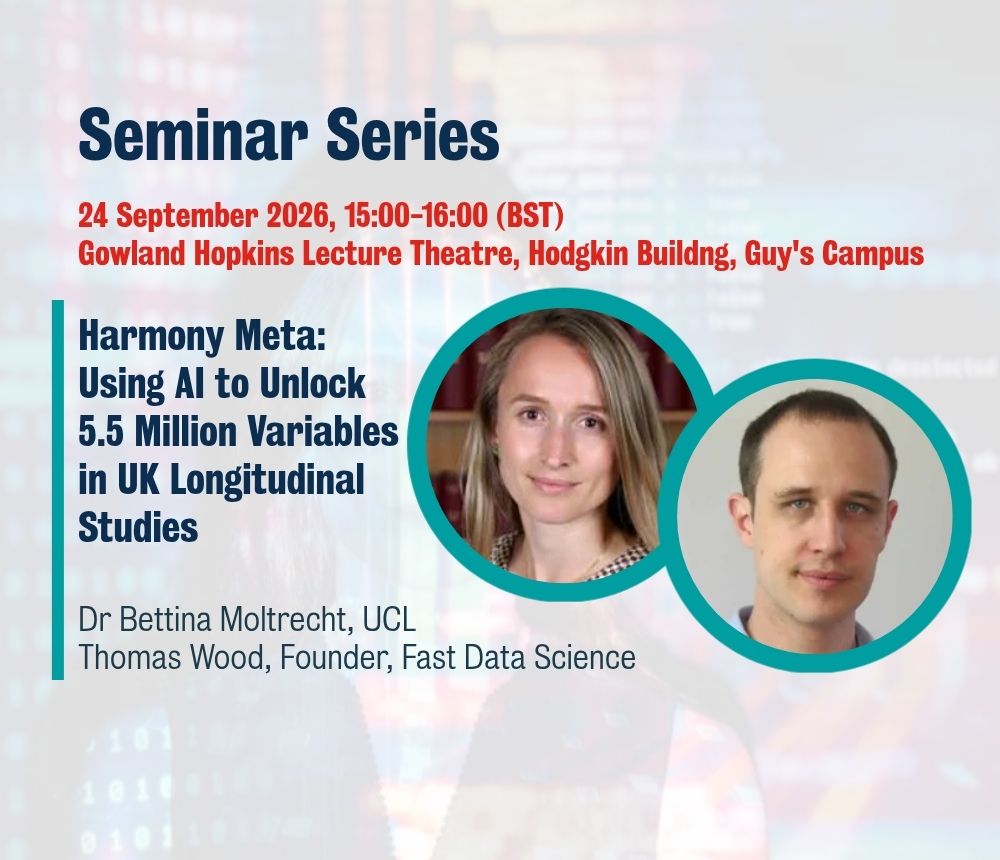
We are looking forward to welcoming Dr. Bettina Moltrecht and Thomas Wood to introduce Harmony Meta , a groundbreaking platform developed over the past year to bridge the gap between disparate study catalogues and registers. While traditional data discovery relies on exact keyword matching, Harmony Meta utilizes Large Language Models and vector indexing to allow for semantic searching across 5.5 million variables . Abstract: This session will demonstrate how researchers can now locate longitudinal data using approximate synonyms—for instance, a search for "dyslexia" will successfully retrieve variables related to "difficulty reading." The platform indexes nearly every major longitudinal study ever conducted in the UK, including the Millennium Cohort Study , the 1970 British Cohort Study , and Born in Bradford . The presenters will discuss the technical backend of converting millions of variables into vectors and the practical implications for harmonizing data across different cohorts to identify population mental health trends. Try the Tool: https://harmonydata.ac.uk/search Seminar Series Event : " Harmony Meta: Using AI to Unlock 5.5 Million Variables in UK Longitudinal Studies" Date and Time: Thursday 24 September 2026, 15:00 – 16.15 (BST) Location: Gowland Hopkins Lecture Theatre, Hodgkin Building, Guy's Campus. Attendance: Mandatory for all DRIVE-Health students; a calendar invitation has already been sent. Registration: Alumni and wider King's College London research community all welcome - please email drive-health-cdt@kcl.ac.uk to let us know if you would like to attend. Biographies Dr. Bettina Moltrecht Dr. Bettina Moltrecht is a mental health researcher based at University College London (UCL) and Anna Freud a UK-based mental health charity for children and families. Bettina combines a clinical, tech and research background, and has been co-leading the Harmony project with the aim to enhance population mental health research. Bettina is co-founder of UCL's Digital Mental Health Hub, and is co-investigator on various clinical trials to evaluate mental health interventions in the NHS. Thomas Wood Thomas Wood is the founder of Fast Data Science and the lead developer for the Harmony Meta backend. He holds a Master’s in Physics from Durham University and a Master’s in Computer Speech, Text and Internet Technology from the University of Cambridge. With over a decade of experience in machine learning and NLP, Thomas has consulted for the NHS, Tesco, and Boehringer Ingelheim. He also works as an expert witness and is working on NLP solutions for clinical trials, and generative AI solutions for legal question answering. Note on Funding and Partners: Harmony Meta was funded by the ESRC and developed in collaboration with Population Research UK (PRUK), the UCL Centre for Longitudinal Studies, DATAMIND UK, The Alan Turing Institute, and UK Research and Innovation.