


Dr Antonio de Marvao February Seminar Series
February 10, 2026
We were pleased to welcome Dr Antonio de Marvao - Clinical Senior Lecturer at King's College London, and Consultant Cardiologist and Obstetric Physician at GSTT and KCH - who delivered his talk “Detecting the Rare, Managing the Common: AI-Driven Cardiovascular Care Using EHR Data"
as part of our Seminar Series.
Abstract: Cardiovascular disease encompasses rare inherited conditions and highly prevalent disorders such as hypertension and cardiometabolic disease. Despite differing epidemiology, both require accurate, dynamic and scalable risk stratification. Electronic health records provide longitudinal, multimodal data at population scale. However, their heterogeneity and fragmentation demand advanced artificial intelligence methods to generate clinically actionable insight. Approximately 70 to 80 percent of NHS data exists in unstructured free text, rendering much of the clinically relevant signal inaccessible to conventional analytics without natural language processing or large language models.
To address this challenge, we have been developing an AI-enabled framework for real-world cardiovascular risk prediction using integrated EHR data. The approach brings together structured clinical variables, imaging outputs and free-text documentation within secure hospital environments. Natural language processing and large language models are used to transform narrative records into computable features, while chain-of-thought reasoning architectures extract guideline-defined risk parameters directly from routine documentation. This enables automated calculation of established risk scores and dynamic longitudinal reassessment within an agentic workflow. Local, open-source models are evaluated across parameter scales to ensure an appropriate balance between accuracy, safety and computational efficiency for clinical deployment.
In inherited cardiac conditions, this approach enables automated extraction of echocardiographic and clinical features required for sudden cardiac death risk prediction, reducing manual burden and supporting real-time monitoring. The same principles extend to hypertensive disorders of pregnancy, facilitating earlier detection, structured surveillance and stratification of long-term cardiovascular risk.
Integration of high-resolution EHR-derived phenotypes with genomic and multi-omics datasets further supports progression from risk prediction to biological insight and therapeutic target discovery. Applied rigorously, AI methodologies operating on routine healthcare data provide a scalable foundation for precision cardiovascular care across the life course.
Seminar Series Event: “Detecting the Rare, Managing the Common: AI-Driven Cardiovascular Care Using EHR Data"
Date and Time:
Tuesday 24 February 2026, 15:30 – 16.30 hrs (GMT)
Location:
IoPPN Seminar 1 & 2, Denmark Hill Campus
Attendance:
Mandatory for all DRIVE-Health students; a calendar invitation has already been sent.
Registration:
Alumni and wider King's College London research community all welcome - please email drive-health-cdt@kcl.ac.uk to let us know if you would like to attend.
Biography
Antonio de Marvao is a Clinical Senior Lecturer at KCL, and a Consultant Cardiologist and Obstetric Physician at GSTT and KCH, specialising in inherited cardiac conditions, maternal cardiology, and hypertensive disorders of pregnancy. His research sits at the intersection of electronic health records (EHR) derived phenotyping, genomics/multi-omics, and cardiovascular imaging, using machine learning to improve risk prediction modelling and personalise care, across the reproductive continuum - from pregnancy to postpartum - and long-term cardiovascular prevention.
He leads work within the NHS England Genomic AI Network, applying natural language processing, large language models and multimodal EHR integration to identify patients with inherited cardiovascular disease, streamline specialist review, and improve access to genetic testing and family screening. In parallel, his group also uses AI and EHR data to better define and detect hypertensive disorders of pregnancy at scale, quantify disparities, and enable earlier, more targeted intervention.
Share
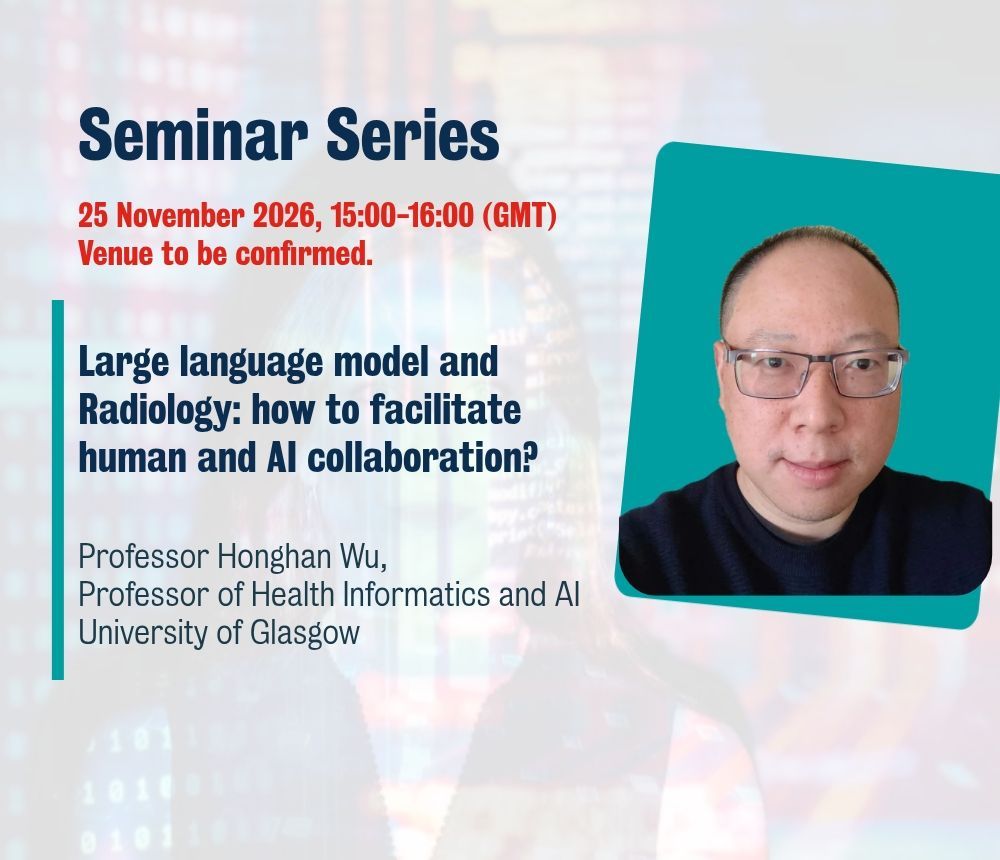
We are looking forward to welcoming Professor Honghan Wu, Professor of Health Informatics and AI at the University of Glasgow, who will deliver his talk “Large language model and Radiology: how to facilitate human and AI collaboration? " as part of our Seminar Series. Abstract: In this upcoming talk, Professor Honghan Wu explores the essential shift from viewing AI as a potential replacement for radiologists to recognizing it as a critical collaborative partner. Moving beyond basic tasks like detection and triage, the presentation highlights how AI can address practical clinical "pain points," such as reducing automated protocoling time by up to 60% and decreasing the time spent communicating with providers and patients by 30%. Professor Wu will present recent research on using knowledge-retrieval and Large Language Models for clinical report error correction and generation. The session concludes with an examination of the real-world deployment lifecycle, discussing the challenges of monitoring the over 700 FDA-cleared radiology AI devices currently in practice Seminar Series Event : “Large language model and Radiology: how to facilitate human and AI collaboration?" Date and Time: Thursday 25 November 2026, 15:00 – 16.00 hrs (GMT) Location: Venue to be confirmed. Attendance: Mandatory for all DRIVE-Health students; a calendar invitation has already been sent. Registration: Alumni and wider King's College London research community all welcome - please email drive-health-cdt@kcl.ac.uk to let us know if you would like to attend. Biography Honghan Wu is a Professor of Health Informatics and AI, based in the School of Health and Wellbeing of the University of Glasgow, where he leads the research theme of data science and AI. Prof Wu is a co-director of Health Data Research Scotland. He also is an honorary professor at Hong Kong University, an honorary associate professor at Institute of Health Informatics, UCL, and a former Turing Fellow of The Alan Turing Institute, UK's national institute for data science and artificial intelligence. Prof Wu holds a PhD in Computing Science. His current research focuses on machine learning, natural language processing, knowledge graph and their applications in medicine.
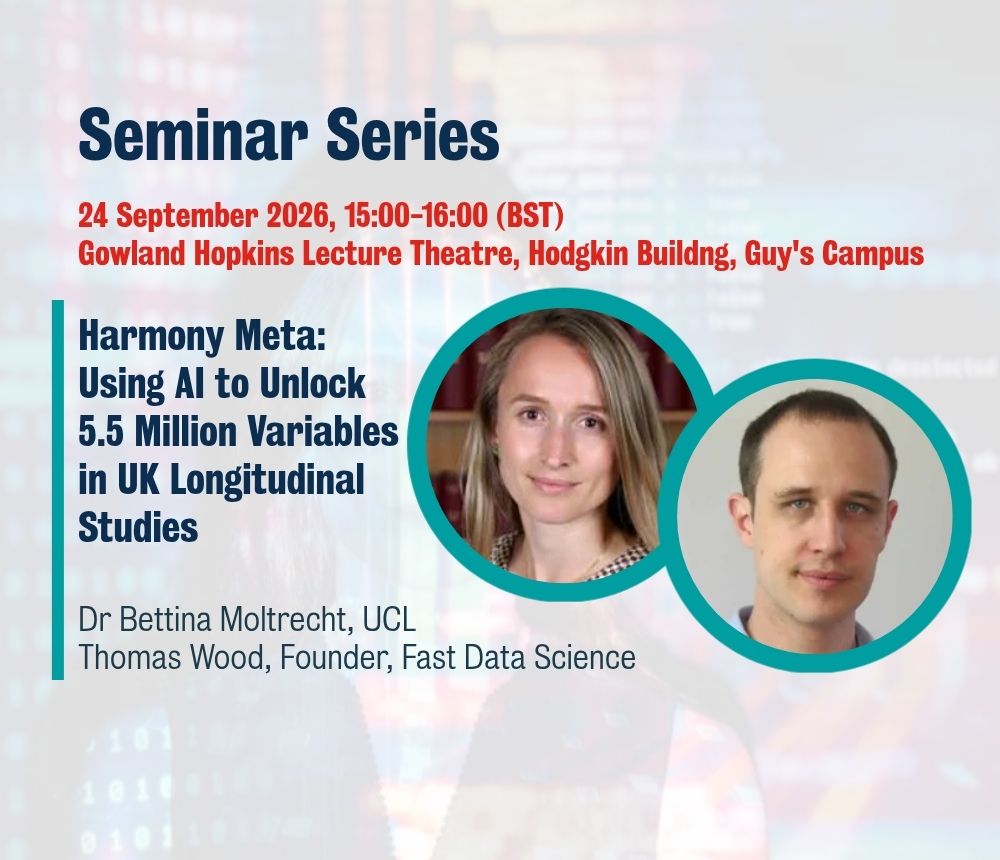
We are looking forward to welcoming Dr. Bettina Moltrecht and Thomas Wood to introduce Harmony Meta , a groundbreaking platform developed over the past year to bridge the gap between disparate study catalogues and registers. While traditional data discovery relies on exact keyword matching, Harmony Meta utilizes Large Language Models and vector indexing to allow for semantic searching across 5.5 million variables . Abstract: This session will demonstrate how researchers can now locate longitudinal data using approximate synonyms—for instance, a search for "dyslexia" will successfully retrieve variables related to "difficulty reading." The platform indexes nearly every major longitudinal study ever conducted in the UK, including the Millennium Cohort Study , the 1970 British Cohort Study , and Born in Bradford . The presenters will discuss the technical backend of converting millions of variables into vectors and the practical implications for harmonizing data across different cohorts to identify population mental health trends. Try the Tool: https://harmonydata.ac.uk/search Seminar Series Event : " Harmony Meta: Using AI to Unlock 5.5 Million Variables in UK Longitudinal Studies" Date and Time: Thursday 24 September 2026, 15:00 – 16.15 (BST) Location: Gowland Hopkins Lecture Theatre, Hodgkin Building, Guy's Campus. Attendance: Mandatory for all DRIVE-Health students; a calendar invitation has already been sent. Registration: Alumni and wider King's College London research community all welcome - please email drive-health-cdt@kcl.ac.uk to let us know if you would like to attend. Biographies Dr. Bettina Moltrecht Dr. Bettina Moltrecht is a mental health researcher based at University College London (UCL) and Anna Freud a UK-based mental health charity for children and families. Bettina combines a clinical, tech and research background, and has been co-leading the Harmony project with the aim to enhance population mental health research. Bettina is co-founder of UCL's Digital Mental Health Hub, and is co-investigator on various clinical trials to evaluate mental health interventions in the NHS. Thomas Wood Thomas Wood is the founder of Fast Data Science and the lead developer for the Harmony Meta backend. He holds a Master’s in Physics from Durham University and a Master’s in Computer Speech, Text and Internet Technology from the University of Cambridge. With over a decade of experience in machine learning and NLP, Thomas has consulted for the NHS, Tesco, and Boehringer Ingelheim. He also works as an expert witness and is working on NLP solutions for clinical trials, and generative AI solutions for legal question answering. Note on Funding and Partners: Harmony Meta was funded by the ESRC and developed in collaboration with Population Research UK (PRUK), the UCL Centre for Longitudinal Studies, DATAMIND UK, The Alan Turing Institute, and UK Research and Innovation.