
First Keynote Speaker Announced

May 17, 2024

We are delighted to announce our first keynote speaker for the EPSRC DRIVE-Health CDT's summer symposium next month.

Dr Dina Demner-Fushman joins us from the National Library of Medicine (NLM) to talk about "Getting AI generated results into decision support workflows: research, clinical and policy perspectives."

Dina will share insights drawn from her experience utilising a Clinical Decision Support (CDS) tab within the National Institutes of Health's EHR system, and present recent research on the application of LLMs for predicting patient outcomes and generating progress notes.


Dina Demner-Fushman, MD, PhD is an Investigator at the National Library of Medicine, NIH, HHS. Dr. Demner-Fushman leads research in the areas of Text and Image Processing for Clinical Decision Support and Education. The outgrowths of these projects are the evidence-based decision support system used at the NIH Clinical Center from 2009 to 2020, an image retrieval engine, Open-i, launched in 2012, and an automatic question answering service CHiQA launched in 2018. Dr. Demner-Fushman earned her doctor of medicine degree from Kazan State Medical Institute in 1980, and clinical research Doctorate (PhD) in Medical Science degree from Moscow Medical and Stomatological Institute in 1989. She earned her MS and PhD in Computer Science from the University of Maryland, College Park in 2003 and 2006, respectively. She earned her BA in Computer Science from Hunter College, CUNY in 2000. She authored more than 300 articles and book chapters in the fields of information retrieval, natural language processing, and biomedical and clinical informatics.


Dr. Demner-Fushman is a Fellow of the American College of Medical Informatics (ACMI), an Associate Editor of the Journal of the American Medical Informatics Association, a member of Nature’s Scientific Data Editorial Board, chair of AMIA NLP SIG (2020-2023), and a founding member of the Association for Computational Linguistics (ACL) Special Interest Group on biomedical natural language processing. As the secretary and now chair of this group, she has been an essential organizer of the yearly ACL BioNLP Workshop since 2007.


Dr. Demner-Fushman has received sixteen staff recognition and special act NLM awards since 2002. She is a recipient of the 2012, 2022, and 2023 NIH Award of Merit, a 2013 NLM Regents Award for Scholarship or Technical Achievement and a 2014 NIH Office of the Director Honor Award.


Registration is required, please email drivecdt@kcl.ac.uk for further event details.


Our annual Symposium is a one-day face-to-face event for all DRIVE-Health students, academic supervisors, stakeholders and partners.  Our aim is to discuss translating scientific and technological innovations in AI and data science, from research to clinical practice and commercial enterprise.


The symposium will feature keynote talks, panel discussions, and poster presentations showcasing cutting-edge research and successful case studies. We will also celebrate our coming together with networking drinks at the end of the symposium.


The EPSRC DRIVE-Health Centre for Doctoral Training is training the next generation of PhD health data scientists to become the innovation leaders of tomorrow. Our students work within an active NHS environment, and develop new models of data-driven care, whilst leveraging significant recent investment and infrastructure in Health Data Research within the UK.


By registering for this event, you give consent to provide your name, e-mail address and registration information with King's College London for the purposes of managing the EPSRC DRIVE-Health CDT's Summer Symposium. Your personal data will be managed by those organisations and by Eventbrite according to their published privacy policies.


Share
March 12, 2026
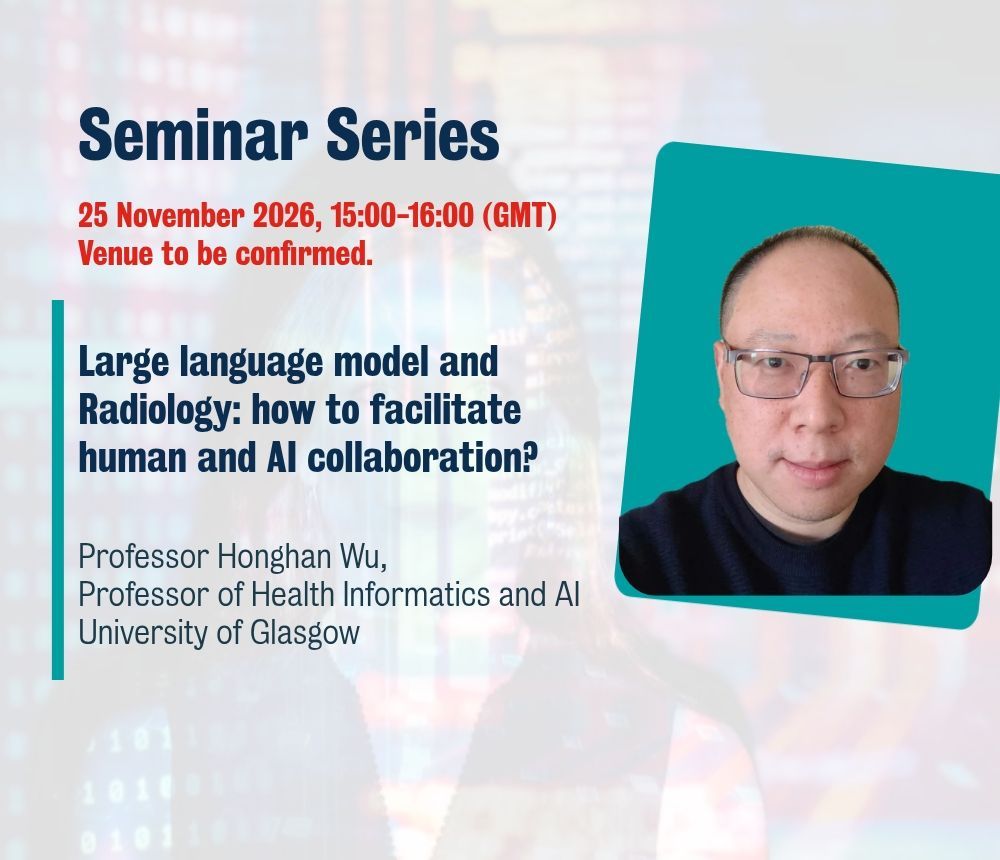
We are looking forward to welcoming Professor Honghan Wu, Professor of Health Informatics and AI at the University of Glasgow, who will deliver his talk “Large language model and Radiology: how to facilitate human and AI collaboration? " as part of our Seminar Series. Abstract: In this upcoming talk, Professor Honghan Wu explores the essential shift from viewing AI as a potential replacement for radiologists to recognizing it as a critical collaborative partner. Moving beyond basic tasks like detection and triage, the presentation highlights how AI can address practical clinical "pain points," such as reducing automated protocoling time by up to 60% and decreasing the time spent communicating with providers and patients by 30%. Professor Wu will present recent research on using knowledge-retrieval and Large Language Models for clinical report error correction and generation. The session concludes with an examination of the real-world deployment lifecycle, discussing the challenges of monitoring the over 700 FDA-cleared radiology AI devices currently in practice Seminar Series Event : “Large language model and Radiology: how to facilitate human and AI collaboration?" Date and Time: Thursday 25 June 2026, 15:00 – 16.00 hrs (BST) Location: Large Committee Room, Hodgkin Building, Guy's Campus Attendance: Mandatory for all DRIVE-Health students; a calendar invitation has already been sent. Registration: Alumni and wider King's College London research community all welcome - please email drive-health-cdt@kcl.ac.uk to let us know if you would like to attend. Biography Honghan Wu is a Professor of Health Informatics and AI, based in the School of Health and Wellbeing of the University of Glasgow, where he leads the research theme of data science and AI. Prof Wu is a co-director of Health Data Research Scotland. He also is an honorary professor at Hong Kong University, an honorary associate professor at Institute of Health Informatics, UCL, and a former Turing Fellow of The Alan Turing Institute, UK's national institute for data science and artificial intelligence. Prof Wu holds a PhD in Computing Science. His current research focuses on machine learning, natural language processing, knowledge graph and their applications in medicine.
March 12, 2026
We are pleased to welcome Simon Ellershaw, PhD Candidate at University College London (UCL) as part of the UKRI UCL Centre for Doctoral Training in AI-enabled Healthcare Systems, who will deliver his talk “Developing Healthcare LLMs: From the NHS to Silicon Valley " as part of our Seminar Series. Abstract: This talk links my PhD and my Silicon Valley internship through one theme: what it really takes to build and deploy LLMs in healthcare. I will introduce Foresight England (Foresight E), a national-scale generative foundation model trained from scratch on 54.9 million de-identified longitudinal NHS EHRs to model patient timelines and enable zero-shot prediction across around 40,000 coded medical events. As NHS England has paused data access pending review, I will focus on the core methodology and lessons learned. I will then switch to my Parexel internship in San Francisco, where I worked in the company’s AI lab on production-focused applications, including pharmacovigilance and protocol de-risking. I will explain how I ended up there, what I worked on, and what I learned, with a candid view of what day-to-day life and work in the Bay Area actually looks like. I will also reflect on how the recent generative AI boom has reshaped the problems teams like ours choose to tackle and the way this work gets built, evaluated, and shipped. Seminar Series Event : “Developing Healthcare LLMs: From the NHS to Silicon Valley" Date and Time: Wednesday 27 May 2026, 15:00 – 16.00 hrs (BST) Location: Judy Dunn, SGDP Building, Denmark Hill Campus Attendance: Mandatory for all DRIVE-Health students; a calendar invitation has already been sent. Registration: Alumni and wider King's College London research community all welcome - please email drive-health-cdt@kcl.ac.uk to let us know if you would like to attend. Biography Simon Ellershaw is a PhD Candidate at University College London (UCL) as part of the UKRI UCL Centre for Doctoral Training in AI-enabled Healthcare Systems, supervised by Prof Richard Dobson and Dr Anoop Shah. His research spans LLM-based generation of hospital discharge summaries, national-scale pre-training of generative models on 57 million electronic health records, and post-training using real-world patient outcomes as verifiable reinforcement-learning rewards. Alongside his PhD, he interned at Parexel AI Labs and now works part-time as an NLP Engineer, developing and deploying production LLM/NLP systems, including applications in pharmacovigilance and quality assurance.